If you visit Olney, England for the expressed purpose of standing on the ground where “Amazing Grace” was written, you will be directed to The Cowper and Newton Museum. For us in America, Newton is the more famous of the two, while in England that position is reserved for William Cowper. William Cowper (Cooper) was born in 1731 in Berkhamsted, England, the fourth child of John Cowper, the rector of the Church of St. Peter. His mother died in childbirth soon after the deaths of William’s older siblings when he was only six, leaving him feeling fear and rejection most of his life. Much of his youth was spend in boarding school where taunts and criticism about his small size brought on despondency. He was trained in law but never practiced it as a trade for fear of the bar exam. He fell in love with his cousin Theodora Cowper but her father refused his intentions. His love poems to her were published ninety-four years later, a testiment to the enduring fellings of his heart that never mended. After studying for a clerks position in the House of Lords, William mentally broke under the pressure of passing the required exam. Three times he tried to comment suicide but even failed at that. After his first asylum stay, he wondered to Olney and was taken in by John Newton, who put him to use visiting members of his parish. There he was befriended by Morley Unwin and his wife Mary and moved in with them in 1765. Morley died from a fall off a horse in 1767, leaving Mary to devote her full attention to William. For many years William was productive in writing his most remembered hymn poetry while next door neighbor to John Newton. William and Mary moved from Olney to Weston in 1786, then to Norfolk in 1795 where she died in 1796, causing William to fall into such a depression that he never recovered. They never married but it seems that their lives were lived for each other. William died in 1800 and was buried just a few feet from Mary.
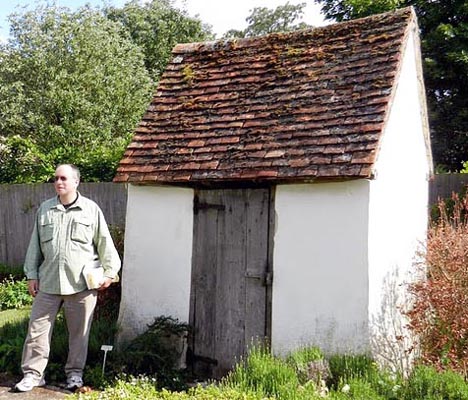
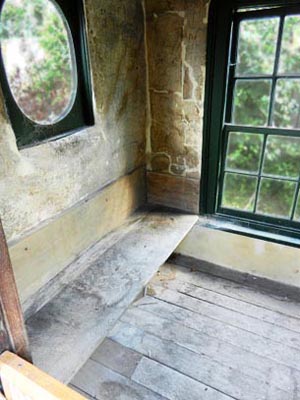
It is those years, from 1765 to 1786, that are of most interest to us. John Newton was the vicor in Olney and took William under his care. William was a gifted poet and translator so John encouraged William on a daily basis. John could even look out his attic study window and see the small secluted garden hut that William would use when writing and they would meet on the garden path between their two homes. To make sure William’s work would survive, Newton, along with Cowper, published a very successful hymnal called Olney Hymns in 1779. Of the 348 poems in the book, 66 were written by Cowper. Even though he was emotionally unstable for much of his life, his songs show little trace of it.
|
|
Some of the more well known hymns of Cowper are: God Moves in a Mysterious Way, O For a Closer Walk With God, There is a Fountain Filled with Blood, and Tis My Happiness Below.
In 1764, friends recommended William check himself into the asylum run by Dr. Nathaniel Cotton, a lover of poetry and a dedicated Christian. It was there, while studying Romans 3: 25 that William Cowper gave himself to the Lord. From those troubled times came the words, “There is a fountain filled with blood drawn from Immanuel’s veins; and sinners, plunged beneath that flood, lose all their guilty stains.” The last stanza goes on to say, “E’er since by faith I saw the stream Thy flowing wounds supply, redeeming love has been my theme, and shall be till I die.”
Soon after the death of Morley Unwin, Mary became deathly ill. Anxiety and depression returned to William with a vengeance. Mary, be older than William, was a mother figure to him. Through the prayers for her, William started to examine his own spiritual condition. He was in Genesis where it reads, “And Enoch walked with God; and he was not; for God took him.” Late that evening, he started writing, “O, for a closer walk with God, a calm and heavenly frame.” He fell asleep without finishing that now famous first stanza. Awakening in the morning, he found the words on his heart that would become two additional stanzas. “Where is the blessedness I knew when first I saw the Lord? Where is the soul-refreshing view of Jesus and His word?” Two questions. My own father had once said that it is OK to question [even God] if you are willing to look for an answer. Cowper’s answer is in the stanzas that read, “The dearest idol I have known, whatever that idol be, help me to tear it from Thy throne, and worship only Thee.” “So shall my walk be close with God, calm and serene my frame; so purer light shall mark the road that leads me to the Lamb.”
When John Newton moved from Olney to London, Cowper turned to writing secular poetry, earning him a prominent place in English literature. He contributed “Pity for Poor Africans” to the abolishion efforts of John Newton and William Wilberforce. During this same period, God Moves in a Mysterious Way was written after a failed suicide attempt. Trying to find the river to throw himself into, the fog was so thick that the carriage driver could not find the river bank. William exclamed to the driver, “God be thanked for having overruled my foolish designs.” The second stanza reads, “Deep in unfathonable minds, of never-failing skill, He treasures up His bright designs and works His gracious will.” The third reads in part, "Judge not the Lord by feeble sense, but trust Him for His grace.”
On his death bed, placed there not by his own hand this time, it is said, “that his face suddenly lighted up with a look of wonder and enexpressible delight.” A few minutes later he uttered, “I am not shut out of heaven after all.” Then he breathed his last.
Depression can cause any of us to question our beliefs and many to question why life should even continue. If allowed to go too far, it can change us into someone not of our own choosing. If you find yourself low, read the hymns of William Cowper. They express the hope God wants for us now and the reality He has waiting for us. http://www.paperlesshymnal.com/tour/
References:
Wikipedia
A Hymn is Born - Bonner / Broadman Press 1959
A Song is Born - Taylor / Taylor Publications 2004
Hymns & History - McCann / ACU Press 1997
Then Sings My Soul - Morgan / Thomas Nelson Publishers 2003
A Literary & Hymn Pilgrimage - Dr. Jerry Rushford 2011