CHARLES WESLEY
CHARLES WESLEY (1707 - 1788)

Charles Wesley, born in 1707 in Epworth, England, died and was buried in London in 1788, was perhaps the most prolific song writer ever to set pen to paper. At age eight he was sent to Westminster School in London and after graduation started studies at Oxford when nineteen. It is said that he wrote between 6000 and 7000 poems. Of these, over 300 survive today in hymn form. We understood what prompted preachers of his day to write. It was a custom for many to end theirs sermons with a new poem that would summarize the preceding lesson. This Charles Wesley did for the many years he spent in the pulpit. But Charles wrote other times, incessantly, even when traveling on horse back, carriage or on foot. His love letters were hymns. He wrote a hymn on his wedding day and even on his deathbed dictated one last hymn to his wife. He rarely revisited a poem to polish it. That job was left up to the many unwelcome "tinkerers" who later published his works.

The Wesley children learned an ordered life from their mother, Susanna, who managed to raise nineteen children. Charles was the eighteenth boy and the youngest. The lessons learned there was the real start of the Methodist movement. Of course, John and Charles Wesley are noted for their involvement in starting the Methodist Church and it was the preaching of Charles' brother John that pushed the new denomination on its way at such a fevered pace. But while it was John's sermons that won fame during their day, it is the poems put to music that keep Charles at the forefront of beloved hymn writers today. Of the many poems he wrote that were set to music, the following are a few of those still sung today.
   A Charge to Keep I Have
All Praise to Our Redeeming Lord
And Can It Be That I Should Gain
Blesses be the Name
Christ the Lord is Risen Today
Come Thou Long Expected Jesus
Hark the Herald Angels Sing
I Know That My Redeemer Lives
Jesus Lover of My Soul
Love Divine All Love Excelling
O For a Heart to Praise My God
O For a Thousand Tongues to Sing
Praise the Lord Who Reigns Above
Rejoice the Lord is King
Soldiers of Christ Arise
 

"Hark the Herald Angels Sing" was hurriedly written in shorthand and laid aside. It was forgotten until a printer needing to fill out a blank space used the poem as filler. It has been edited so many times over the years that few lines remain today as he wrote it but is sung today more than any of his other songs. The first line as originally written says, "Hark, how all the welkin rings", welkin being an old English term for "the vault of heaven." It was first sung to the tune "Worgan" or "The Easter Song", the tune we still sing for Wesley's "Christ, the Lord, Is Risen Today". Later it was married to Mendelssohn's Feste-gesang, Op. 68, No. 7. For more details of this song text and music, click here to listen to Dr. Jerry Rushford tell the story.

The inspiration for so many works came from everywhere. "A Charge to Keep I Have" and fifteen other hymns followed the study of Leviticus. His own conversion prompted "And Can It Be That I Should Gain" while the anniversary of that conversion inspired "O For a Thousand Tongues to Sing". But most of his poems came from ordinary occurrences in life: nature, spoken phrases, lessons learned, inward feelings of gratitude, etc.

The Wesley's were opposed to instrumental music during the services. To quote John, "I have no objection to instruments of music in our worship, provided they are neither seen nor heard."
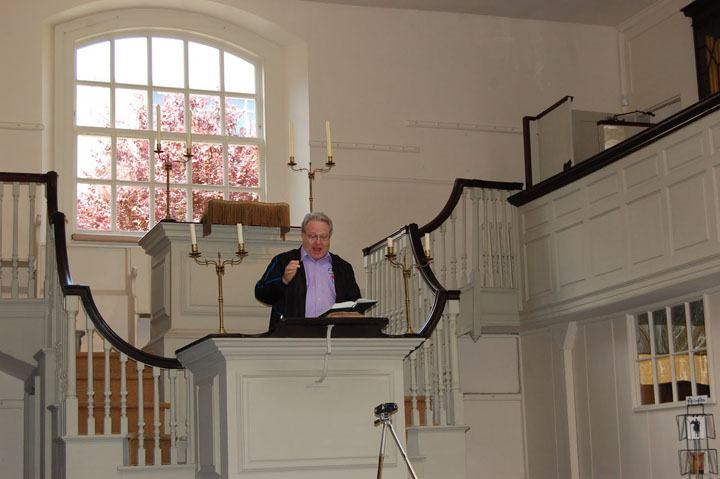

Leading a Wesley hymn from the leader's pulpit in the Wesleyan Chapel, Bristol, England (photo by Karen Hughes)

References:
Adam Clarke's Commentary 1832
A Hymn is Born - Bonner / Broadman Press 1959
Hymns & History - McCann / ACU Press 1997
Then Sings My Soul - Morgan / Thomas Nelson Publishers 2003
Stories of Hymns We Love - Rudin / John Rudin & Co. Inc. 1941
A Song if Born - Taylor / Taylor Publishing 2004
A Literary & Hymn Pilgrimage - Dr. Jerry Rushford 2011